Roots, Paths and Hope: celebrating our history, reinventing the future
“As you therefore have received Christ Jesus the Lord, continue to live your lives in him, rooted and built up in him, established in the faith, and abounding in thanksgiving” (Colossians 2:6–7).
Recife, 1 May 2026
Feast of Saints Philip and James, Apostles
International Workers’ Day
Easter Season
To the communities of the Anglican Diocese of Recife, of the Episcopal Anglican Church of Brazil and of the Anglican Communion,
to our sister churches and faith communities,
to public authorities and movements of civil society,
to the people of Northeastern Brazil and of our nation,
Peace be with you.
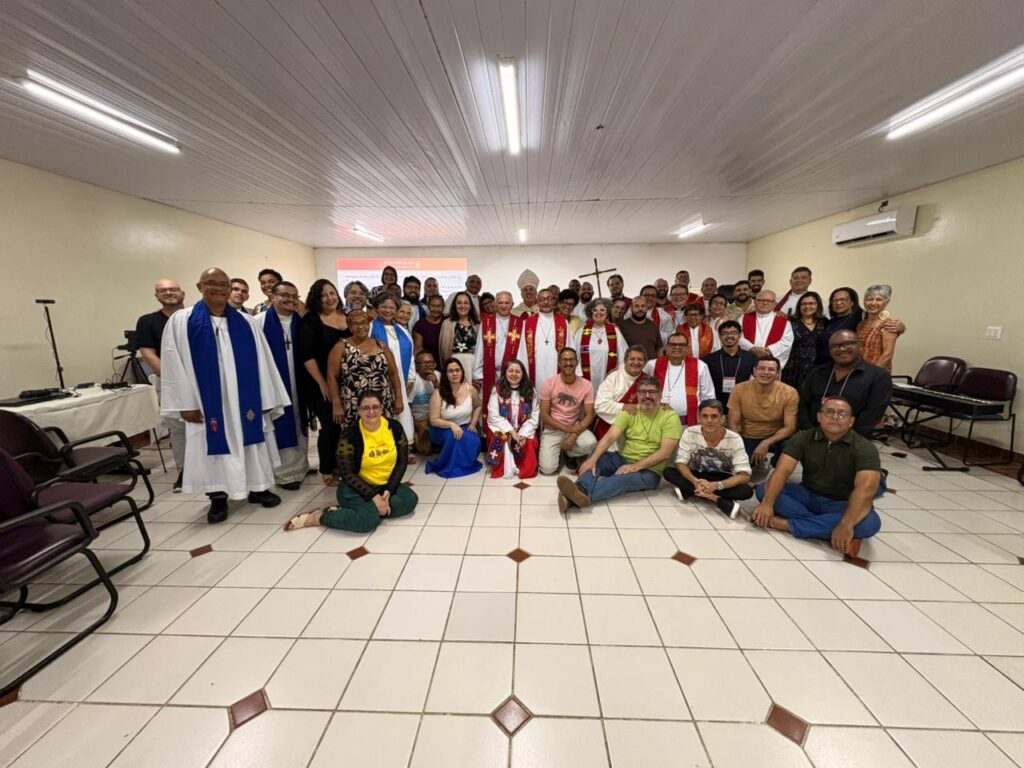
Gathered in Synod as clergy and lay representatives of our communities, we celebrate, in this season, the fiftieth anniversary of the Anglican Diocese of Recife. It is a Jubilee celebration. We do so on a date filled with meaning: the liturgical remembrance of Saints Philip and James, apostles, witnesses of the risen Christ and sent to proclaim the Gospel amid the complexities of their own time; and International Workers’ Day, which reminds us of the dignity of human labour, of the historic struggles for justice, and of the challenges still faced by millions of people throughout the world. In harmony with the Franciscan and Clarian spirituality present within our Diocese, we also remember that work can become an expression of care, service and mission when lived as a humble and loving participation in God’s reconciling work in the world.
This 37th Diocesan Synod takes place at a deeply symbolic moment in our history. It not only recalls the path we have travelled, but also calls us to listen, with attentiveness and
responsibility, to the signs of our times — times marked by profound crises, but also by real possibilities for transformation. We celebrate, therefore, not merely a chronological milestone, but a providential moment (kairos) of living memory, collective discernment and renewed commitment to God’s mission in the world.
It is within this horizon that we offer this Pastoral Letter as a communal effort to read reality in the light of the Gospel. A word born from the memory of our roots, committed to the paths we are building together, and open to the hope that moves us forward.
Inspired by the theme “Roots, Paths and Hope: celebrating our history, reinventing the future”, and by the apostolic exhortation to remain “rooted and built up in Christ, established in the faith, and abounding in thanksgiving,” we seek, in this text, to share a word of faith, responsibility and commitment addressed both to the Church and to society, in a time that calls us to courage, clarity and faithfulness to God’s call to life.
In embracing this exhortation, we are also led to the question that runs through this Synod: how have we received Christ Jesus? In the Easter Season, the narrative of Emmaus offers us a precious image through which to answer. We receive Christ along the road, when hope itself has been wounded; we receive him as the presence who draws near, asks questions, listens, interprets the memory of faith, breaks bread, and sends the community back into mission. To remain rooted in Christ, therefore, does not mean immobility, repetition or closure, but a living faithfulness capable of journeying, discerning and bearing witness.
1. Roots: memory and gratitude as sources of inspiration, learning and strength
To speak of roots, for us, is to speak of living memory — not as an idealised return to the past, but as the recognition of a concrete history in which God continues to act, sustain, unsettle and call us into faithfulness. Our roots are not static. They deepen in the soil of history, pass through conflicts, endure seasons of drought, and continue to nurture life even when circumstances seem adverse. For this reason, remembrance, at this moment, is not merely an act of gratitude, but a spiritual and theological-political practice. It requires us to look back in order to understand who we are, to discern what we have learned, and to renew the courage to continue forward.
The Anglican presence in our region long predates the creation of the Diocese itself. As early as the nineteenth century, the first British chaplaincies emerged in the port cities of Recife, Salvador and Belém — places that would historically shape the life of our Diocese. At that time, this presence remained limited, directed primarily toward foreigners and English-speaking immigrants, without any broader commitment to the social, cultural and religious life of the country. For decades, this model defined the contours of Anglican presence in Northern and Northeastern Brazil, reflecting the limits of a Church still strongly tied to external projects and only lightly rooted in local realities.
This landscape began to change during the 1960s and 1970s, when the Episcopal Anglican Church of Brazil gained its autonomy from the Episcopal Church and, with it, began to articulate a new understanding and horizon of mission. It was no longer sufficient merely to offer people a religious and pastoral path; the Church was called to discern God’s voice in a country living under military dictatorship, deeply marked by regional inequalities, brutal socioeconomic exploitation in rural areas and urban peripheries, and an authoritarian, violent and exclusionary political regime. At the same time, the Brazilian Christian religious landscape was shaped by a sharp divide between Catholic tradition and Protestant-
Evangelical preaching — a landscape often resistant to public dialogue and frequently complicit, whether actively or silently, in the social and political injustices that wounded the life of the people.
It was within this context that the Anglican Diocese of Recife was born in 1976. Its creation cannot be understood merely as an administrative development, but rather as the sign of a deeper transformation in the Episcopal Anglican Church of Brazil’s understanding of mission — a mission increasingly embracing its public, incarnational and prophetic dimensions. From the outset, the Diocese was called to exist not at the margins of society, but within its tensions and contradictions, seeking to embody a Christian witness that would be at once faithful to the Gospel and relevant to the concrete realities of people’s lives.
Over time, this vocation took shape through commitments to democracy, social justice and the defence of human rights, as well as through openness to ecumenical and interreligious dialogue and the affirmation of freedom of thought and pluralism. In a context often marked by exclusion and silencing, the Diocese became, for many people, a place of refuge and welcome — especially for those who found themselves marginalised, rejected or displaced for refusing to conform to dominant Christian discourses.
This path, however, was not free from conflict. On the contrary, it was marked by profound tensions, which intensified especially from the early 2000s onward, when the Church was compelled to position itself regarding questions of gender, sexuality and full inclusion. The defence of women’s ordination, the recognition of the dignity and vocation of LGBTQIA+ people, and their full participation in the sacramental and ministerial life of the Church led to painful ruptures, institutional losses and moments of deep fragility.
These experiences cannot be romanticised. They left wounds. Yet they also revealed something fundamental about who we are and about the kind of faithfulness to the Gospel we seek to uphold — a faithfulness measured not by the preservation of superficial consensus, but by the willingness to discern, even amid conflict, where life is being affirmed, and to stand alongside it.
In the light of Easter, these wounds may be recognised as paschal scars. The Risen Christ does not erase the marks of the Crucified One; rather, he transfigures them into presence, memory and mission. So too, we are not called to hide our wounds, nor to transform them into resentment. We are called to read them truthfully, so that they may become sources of learning, responsibility and care for communion.
In recognising this, we are also called to look honestly at our own limitations. Our history is not made only of successes. We carry contradictions, mistakes, silences and omissions. We have not always lived up to the principles we profess, nor have we always succeeded in translating into practice the full implications of our own theology. Yet it is precisely through this recognition that the possibility of maturation emerges. Memory, when traversed by truth, does not paralyse us — it transforms us.
Within this process, the Anglican Seminary for Theological Studies (SAET) and the Cathedral of the Good Samaritan (CABS) occupy a singular place in our journey. During the most difficult moments, when the Diocese found itself fragile and with few spaces for gathering and mutual support, SAET became far more than a centre for theological formation: it became a place of resistance, encounter and the reorganisation of communal life. There,faith was sustained, leaders were formed, and hope found concrete ways to remain alive. The reopening of the Cathedral in 2016, in turn, did not represent a simple return, but the visible expression of a process of reconstruction. The community that reconstituted it carries within itself the memory of those years of crossing, and for that very reason, the Cathedral became a symbol of rebirth — a space that not only preserves history, but projects it into the future.
Thus, when we speak of our roots, we speak of a history marked by displacement, conflict and new beginnings, yet sustained by a stubborn insistence on life. A history explained not merely by our own decisions, but by the action of God who, even amid our fragilities, continues to call, sustain and send us. It is from this memory — shaped by gratitude, but also by truth — that the inspiration, learning, courage and strength we need in order to continue emerge. For our roots do not imprison us or bind us to a fixed place; they sustain us for what is still to come.
2. Paths: discerning our time and our place in order to build a new reality through faith in Christ
If our roots offer us memory and grounding, the paths before us place us before a permanent task: to discern the time in which we live, to recognise the place we occupy within it, and to take responsibility for building new possibilities for life through faith in Christ. To journey, in this sense, is not merely to move forward, but to learn how to read reality — with clarity, humility and courage — and to respond to it faithfully and creatively.
Today, the Anglican Diocese of Recife faces challenges that are not merely internal but reflect broader tensions within Anglicanism, within the Brazilian religious landscape, and within the social, political, and cultural dynamics of Northeastern Brazil, of our country, and of the wider world. We are not outside these crises. We are within them. And it is from this situated and concrete place — marked by both limitations and possibilities — that we are called to discern our paths.
One of our most immediate challenges has been the institutional and pastoral reconstruction of the Diocese following the ruptures of the early 2000s. This process involves far more than reorganising structures or rebuilding leadership and communities. It is deeper work: rebuilding relationships, restoring trust, and learning anew how to be Church in a context marked by loss, displacement and new beginnings. This journey has required patience, perseverance, and a constant willingness to engage in dialogue and share responsibility.
At the same time, this process calls us to rethink and renew the very Anglican experience we seek to embody. It is not a matter of merely repeating inherited models, nor simply adapting them, but of discerning how the Gospel may be lived and proclaimed meaningfully within our own context. This requires us to recognise, with seriousness and humility, that God’s loving presence and action are not confined to the traditional forms of the Church, but are manifested in the histories, cultures, forms of knowledge and lived experiences of people and communities that have often been marginalised, subordinated and excluded.
Within the Northeastern Brazilian context, this calls for us to pay particular attention to the richness and complexity of the cultural, artistic, musical, and spiritual expressions that permeate the lives of the people. In Indigenous, quilombola (Afro-Brazilian communities rooted in histories of resistance to slavery), rural and peasant traditions, and in the many forms of life emerging from urban peripheries, we encounter ways of existing, resisting and celebrating that carry depths of meaning which theological reflection and ecclesial practice cannot afford to ignore. These are experiences profoundly shaped by relationships to land, memory, the body and the affections — dimensions often marginalised by more rationalised and normative ways of living the faith.
To learn to recognise the breath of the Holy Spirit within these contexts requires a displacement of our gaze. It means acknowledging that God continues to reveal Godself through languages, gestures, rhythms, narratives and practices that do not fit neatly within the Church’s traditional frameworks. It means recognising wisdom in oral traditions, in music, in dance, in communal celebration, in daily resistance, and in forms of spirituality forged through the confrontation with suffering and through a stubborn insistence on life. This is not about replacing one tradition with another, nor about dissolving Anglican identity, but about allowing that identity to be crossed, questioned and enriched by these experiences.
At the same time, this recognition challenges us to avoid both idealisation and superficiality. We cannot romanticise these realities, nor treat them as folklore or as aesthetic resources to be appropriated uncritically. These cultures and spiritualities are themselves marked by tensions, conflicts and ambiguities. To listen to them responsibly requires acknowledging their complexity, their wounds, and their contradictions, without reducing them either to empty symbols or to exoticised expressions.
We are therefore called to a deeper practice of listening and learning — a listening that seeks not merely to “include” the other, but to be transformed by encounter itself. This has concrete implications for the way we think and live our faith. It challenges our theology, calling us to engage in dialogue with other forms of knowledge and to recognise other epistemologies. In the area of our ecclesiology, inviting us to imagine forms of Church that are more open, less centralised, and more deeply rooted in the concrete life of communities. It provokes our liturgy to welcome the diversity of languages, bodies, and expressions that make up the People of God. It reshapes our missiology, moving it away from a logic of transmission toward one of encounter and shared life. And it reconfigures our pastoral practice, summoning us to act with greater sensitivity, humility and commitment to local realities.
Another decisive challenge concerns the sustainability of diocesan life itself. Building a Church committed to mission also requires responsible stewardship of resources. Financial sustainability is not a secondary concern, but an integral part of our faithfulness. This calls for ethical, transparent and responsible forms of administration, while also strengthening the autonomy and shared responsibility of each local community. The issue is not simply maintaining structures, but ensuring that the mission may continue to be lived consistently and with integrity.
Along this path, the formation of leadership becomes an unavoidable priority. We need people who are spiritually mature, theologically grounded and pastorally sensitive — people capable of engaging the complexity of our time, learning continuously, confronting conflict, and nurturing living communities. Leaders who seek not personal prominence or individual recognition, but who know how to build collectively, rooted in the tradition of the Church and attentive to the local realities of each parish and mission.
Such a formation requires us to distinguish clearly between authority and authoritarianism. Christian authority must never be confused with domination, control or the imposition on consciences. At its best, authority is the capacity to nurture life: to sustain those who are falling, to uphold dignity, to open paths for discernment, and to serve the maturation of the community. Authoritarianism is its distortion: it suffocates difference, monopolises speech, weakens relationships and transforms care into control. We must form leaders shaped by evangelical authority, not by the desire for power.
This challenge becomes even more urgent in a context marked by profound transformations in the ways human beings relate to one another. We live in a time when powerful technologies of information and communication are reorganising social life, often producing isolation, fragmentation, distrust, and unhealthy competition. In such a context, living the communal vocation of Christian discipleship becomes, in itself, a countercultural act. To be Church today also means learning how to rebuild bonds, cultivate trust and sustain real experiences of communion.
At the same time, we are confronted by a political and social landscape increasingly marked by authoritarian discourses and practices. On many levels, we witness the growth of dynamics rooted in stigmatisation, subordination and the production of fear and hatred, especially against historically vulnerable groups — women and girls, Black people, LGBTQIA+ people, impoverished and homeless populations, Indigenous peoples, among others. These dynamics have deeply transformed contemporary social and cultural realities and have found significant resonance within sectors of the Christian religious field, which increasingly justify, legitimise and, in some cases, actively promote such processes.
For this reason, we recognise that confronting authoritarian threats also requires spiritual discernment concerning the religious images we cultivate. Any image of God used to legitimise absolute submission, fear, exclusion, violent hierarchy or the sacrifice of vulnerable bodies betrays the Gospel of Christ. The God we meet in Jesus is not a holy reflection of the powers that dominate this world; this God is made known through care, justice, mercy, generous sharing, and a life that refuses to surrender to death.In the face of this reality, our prophetic vocation becomes unavoidable. We cannot remain silent before violence, nor accommodate ourselves to injustice. We are called to name these realities, to denounce them, and to stand alongside those who suffer their consequences. This also includes confronting the forms of state violence intensified within this context, as well as the new configurations of imperialism and colonialism that destabilise international relations and fuel conflicts and wars in different parts of the world, including Latin America.
These realities are not distant from us. They traverse our lives. For this reason, we cannot ignore the suffering of entire peoples now living under constant threat. Ongoing wars, the devastation of territories, policies of extermination, genocide, ethnic cleansing and forced displacement — as we witness so tragically in Gaza and throughout Palestine — profoundly challenge us as Church. Not as distant observers, but as part of a global community of faith called, in every circumstance, to bear witness to the non-negotiable value of life.
Within this same horizon, the environmental crisis and climate change stand among the greatest challenges of our generation. The destruction of creation, the deepening of environmental inequalities, and the disproportionate impact upon vulnerable populations — often shaped by dynamics of environmental racism — demand from us a consistent theological and pastoral response. This necessarily involves rediscovering and
rearticulating the sacramental dimension of life, recognising that all creation participates in the mystery of God and therefore cannot be treated as a disposable resource.
Faced with so many challenges, the path ahead may at times appear uncertain or even impassable. Yet it is precisely here that faith in Christ sustains us — not as a guarantee of easy answers, but as the horizon that enables us to continue journeying, discerning and building, even amid tension and uncertainty. Our paths are not predetermined. They are made in the process itself. And it is within that process that we are continually called to live faith not merely as refuge, but as a transformative force.
To discern our time, recognise our place within it, and take responsibility for building new realities: this is the challenge set before us. Not alone, not from positions of absolute certainty, but in communion, with humility and with the courage of those who know that the Gospel remains, even today, good news for the world.
3. Hope: our radical commitment to God’s mission and to Anglican witness in Brazil and Northeastern Brazil
If our roots sustain us and our paths challenge us, hope is what moves us forward. Not as vague expectation or mere consolation in the face of difficulty, but as a radical commitment to God’s action in history. Christian hope is not an escape from reality; it is the decision to remain within it, even when marked by impasses, contradictions and suffering, trusting that God’s love continues to work persistently, opening possibilities where none seem to exist.
To celebrate the fiftieth anniversary of the Anglican Diocese of Recife within this horizon is more than giving thanks for what has passed. It is to renew, with awareness and responsibility, our commitment to God’s mission — a mission of ongoing reconciliation that does not ignore conflict, but passes through it; that does not erase differences, but transforms them into possibilities for communion; that is not satisfied with preserving what already exists, but points toward a horizon of life marked by love, justice, equality, freedom and creativity.
It is in this spirit that we reaffirm our commitment to Anglican witness in Brazil and, in a particular way, in Northeastern Brazil. A witness inspired by the Five Marks of Mission, calling us to be a Church that proclaims the Gospel, forms disciples, responds to human need through loving service, challenges unjust structures of society, and safeguards the integrity of creation.
As a Northeastern Brazilian Diocese, we live out this witness in communion with the whole Anglican family. We participate in the Anglican Communion not merely as those who receive guidance from elsewhere, but as those who enter into a living conversation: receiving, translating, questioning and offering back the paschal wisdom born from our own soil. Northeastern Brazil — with its wounds, cultures, spiritualities, resistances and hopes — also interprets the Gospel and contributes to the discernment of the Body of Christ in the world.
We seek to continue being an inclusive Church, one that welcomes without reservation and recognises the full dignity of every person. A Church attentive to the wounds of the world, capable of offering care, attentive listening, and paths toward healing and growth. A Church open to ecumenical, interreligious and cultural dialogue — a Church that does not fear difference, but recognises it as a place of encounter and learning.
At the same time, we reaffirm our prophetic vocation as faithfulness to the Gospel that calls us to denounce all that denies life. We remain committed to the struggle for social justice, to human rights’ advocacy, and to the building of a more democratic, just and equal society, especially alongside those people and communities that continue to be marginalised and excluded.
This hope is also embodied in our care for the continuity of the faith we have received. We are heirs to a history that does not belong to us alone, but has been entrusted to us. For this reason, we renew our commitment to share with new generations not merely doctrines or content, but a living experience of faith shaped by memory, learning and openness to what is new — a faith that does not close itself within the past, but continually reinvents itself in listening to the Spirit.
Within this same movement, we recognise the importance of strengthening our institutional life. Not as an end in itself, but as support for mission. A Diocese with organised structures, democratic and participatory practices, and responsible financial sustainability is better able to care for its people and to respond consistently to the challenges of the present time. We therefore reaffirm our commitment to building a Diocese that becomes ever more a place of refuge, growth and strengthening for people — a place where the call of the Holy Spirit may be heard, discerned and answered.
The hope we profess, therefore, does not ignore the complexity of the world. Nor does it allow itself to be paralysed by it. It is a hope that persists, resists and commits itself. A hope translated into practice, into community and into mission. It is from this hope that we continue onward.
4. Sending Forth: reinventing the future
Every memory that shapes us also sends us forth. It does not allow us to remain where we are. On the contrary, it unsettles us, calls us, and sends us once again into mission. For us, reinventing the future does not mean abandoning who we have been, but recognising that our history remains open and that we are called to participate actively in its ongoing construction.
Throughout its journey, the Anglican Diocese of Recife has learned that it does not originate from itself. It emerges from God’s mission. And it is from that same mission that it continues to be reborn, again and again, especially in moments when everything seems uncertain. We are sustained not by our own strength, but by the grace that calls us, gathers us and sends us forth.
At the conclusion of this Synod, we are sent once more — not as those who possess all the answers, but as those who carry with them a history marked by God’s faithfulness, the lessons of a journey still unfolding, and the hope of a future that is still being woven.
As at Emmaus, the recognition of Christ in the breaking of the bread does not confine us to a private spiritual experience. It returns us to the road, to the community and to the city. The Synod that celebrates our roots also sends us into those places where hope has been wounded: to listen, to care, to denounce injustice, to share bread, and to bear witness that no authoritarian power has the final word over life.
We continue as people rooted in the Gospel, walking in communion with the people and committed to life in all its forms. We continue in confidence that, as Scripture teaches us, those who remain in Christ continue to bear fruit even in difficult times (Jeremiah 17:8).
With gratitude for what we have lived, with responsibility before the present, and with hope for what is still to come, we continue onward.
Anglican Diocese of Recife
37th Diocesan Synod